
By James Palmer

Law360 Canada (November 16, 2026, 2:39 PM EST) — On Nov. 5 of this year, the Paris Judicial Court annulled Sotheby’s June 2024 London sale of Camille Pissarro’s 1902 painting Darse de pêche et bassin Duquesne, Dieppe, après-midi ensoleillée (1.2 million pounds) and ordered it returned to the descendants of the Jewish banker Salomon Flavian. While the ruling was viewed as a victory for Holocaust-era restitution, a closer examination of the facts, as well as the courtroom dynamics, reveal deep flaws in both the factual reasoning and the legal mechanics of the decision.
Both Corinne Hershkovitch, attorney for the plaintiffs, and Melina Wolman of Pinsent Masons, representing Mondex, agreed that the British collector Edward Le Bas owned the painting in England by the early 1950s. At the same time, archival records from the dealer Paul Rosenberg indicate that the painting was at the Rosenberg Gallery in 1937 with a note of the name Le Bas connected with the painting, and the authoritative 1939 Pissarro catalogue raisonné (compiled by Lionello Venturi) explicitly lists Le Bas as the owner of the painting before World War II began.
Because Le Bas held the painting in 1939 and still held it in the early 1950s, Salomon Flavian could not have possibly been despoiled of the painting in 1941.
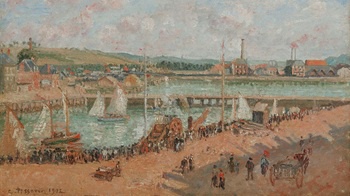
Despite this very coherent set of facts and despite the fact that provenance experts of Mondex Corporation, Sotheby’s and Sotheby’s external, contracted provenance expert have decades of expertise in this type of forensic research, and that all of them concluded that the painting was not looted, the Paris court dismissed the 1939 catalogue raisonné and Rosenberg records as merely “contradictory elements,” demanding direct 1930s invoices to prove how the painting moved from Flavian back to Rosenberg and on to Le Bas while treating Flavian’s 1935 acquisition of the painting and his uncorroborated 1946 postwar claim list as definitive proof.
Unlike the U.K., Germany, the Netherlands, Austria and Switzerland, which rely upon expert restitution panels with vast provenance experience, France leaves private restitution disputes to more rigid civil courts, which operate under the 1945 spoliation ordinance, and which often have very limited experience in provenance research and related issues.
For example, it is not by chance that one of the most crucial principles of these well-established European restitution commissions is their treatment of evidentiary gaps and wartime ambiguities, which are weighed in favour of claimants only in the absence of evidence to the contrary. This is where the major problem arises, as the Paris court ignored the objective prewar and postwar evidence and instead gave it no weight whatsoever. Instead, it relied upon the fact that Flavian had simply claimed that he had been despoiled of the painting, and such an allegation, unto itself, is certainly insufficient.
The courtroom dynamics become clearer when consideration is given to the fact that the attorney for the plaintiffs, Corinne Hershkovitch, is not merely an independent litigator but also a competitor of Mondex in the French art restitution market, pitting an all-or-nothing litigation model against Mondex’s pragmatic settlement approach.
Throughout the proceedings and in post-verdict press statements, Hershkovitch used the platform to publicly disparage Mondex’s competence and mission, which was a tactic Mondex’s counsel explicitly flagged in court as an effort to damage a commercial rival rather than resolve a genuine historical injustice.
As the matter proceeds to appeal, it will be interesting to see if the appeal court takes a different view with respect to it benefiting from the help of a third-party provenance expert. Interestingly, the court of the first instance unilaterally drew the conclusion that no provenance expert was needed for it to make an informed decision, notwithstanding the court’s refusal to assign any weighting to the evidence observed, nor apparently being aware of the general dispositions of the various European restitution committees and the importance that they place on objective evidence, which may contradict the allegation of a claimant.
Hopefully the appeal court will give significant weight to the catalogue raisonné provenance, the Rosenberg archival records and their connection to the jointly accepted fact that the painting’s prewar owner was the same person who owned it in the early 1950s. Ultimately, the higher court will be forced to decide whether French restitution law is governed by verifiable historical documentation or by postwar assertions insulated from scrutiny.
James Palmer established Mondex Corporation in 1993. Driven to do work of meaning, in 1998, encouraged by the Washington Principles, James worked to develop Mondex’s expertise to include the restitution of looted art and other cultural property. Since then, Mondex has cooperated with ministries of culture in the Netherlands, France, Germany and Poland to help shape their restitution policies. James completed his studies at the Canadian universities of York, Laurentian and Western, as well as the University of Nice in France and Heriot-Watt University in Scotland. He holds an honours BA and an MBA, and currently acts as a consultant for Mondex.
The opinions expressed are those of the author and do not reflect the views of the author’s firm, its clients, Law360 Canada, LexisNexis Canada or any of its or their respective affiliates. This article is for general information purposes and is not intended to be and should not be taken as legal advice.