
By Leo Sisti – September 25, 2026
The Panama Papers reveal the truth about the painting stolen by the Germans and “shielded” by a Lebanese Jewish dealer. The owner’s heir has won the first round. A dispute over compensation.

Since last spring, the news has featured more stolen masterpieces. Three at the Magnani Rocca Foundation in Traversetolo, in the province of Parma: Cézanne, Renoir and Matisse, worth €9 million. All recovered in August. That month also saw 3 of the 5 panels of Antonello da Messina’s San Gregorio Polyptych vanish from the museum in Messina, only because the thieves lost 2 along the way.
A theft solved in a few weeks is a rare occurrence. In fact, it often takes decades. As in the story of a famous 1918 painting by Amedeo Modigliani, “Seated Man with a Cane.” A real drama, against the backdrop of World War II.
On March 21, 1930, the English Jewish antiques dealer Oscar Stettiner writes from Paris to the Venice Biennale. He announces his wish to lend that canvas, which he owns, to the 17th International Exhibition, scheduled from May to November. With the outbreak of the conflict in September 1939, he flees his home on Rue du Cirque in November and takes refuge in the Dordogne. He fears deportation. In June 1940, Paris is occupied by the Germans. During the war, the Modigliani painting is confiscated by the Nazis. During that period, despite his hardships, Stettiner manages to survive, but dies in 1948. On April 3, 2026, his heir, his grandson Philippe Maestracci, a farmer, wins the lawsuit for the restitution of that treasure. More than eighty years have passed. An odyssey to be told.
The fate of that Modigliani was debated during a legal battle won by Stettiner’s grandson before the Supreme Court of New York. It is the latest twist in a dark thriller. The case, according to Justice Joel Cohen’s ruling, involves two opposing sides. On one side, the “Stettiner Estate,” with Maestracci in support. And on the other, David Nahmad, a Lebanese billionaire. His father was a Jewish banker from Aleppo who fled Syria, then settled in Beirut and, in the 1960s, in Milan, with his other two sons, Giuseppe and Ezra. From there, David would later set his sights on New York, becoming one of the leading international gallery owners.

He was the one sued, together with the “International Art Center” (IAC), an offshore company in Panama that was, for years, the official owner of “Seated Man with a Cane.” In reality, as will become clear, a front concealing David Nahmad himself.
Defeated at this first stage, David Nahmad takes countermeasures. He appeals in June, before the expiration of the 30-day deadline set by the judge. His aim is clear: to prevent the restitution of the work, now held at the Geneva freeport, where it has been stored for years.
A temporary setback for Philippe Maestracci. He has never given up over the loss of “his” Modigliani. For almost 17 years, he has been assisted by Mondex Corporation, a Canadian company specializing in tracking down masterpieces looted by the Nazis in galleries, museums or foundations. With notable precedents. Thus, two oil paintings by Kandinsky, “Bild mit Häusern” (1909) and “Das bunte leben” (1907), which had ended up in a Dutch museum and a German bank, were handed over in 2022 and 2023 to the rightful heirs of the Dutch Jewish Lewenstein family. And a beautiful canvas by Chagall, “Le Père,” taken by the Germans from a Polish Jewish musician, David Cender, in the Lodz ghetto in Poland, was likewise returned to his descendants in 2022.
Achieving these successes involves searching archives, libraries, museums and exhibitions. James Palmer, who founded Mondex in 1993, tells L’Espresso: “For that Modigliani, there were three challenges: proving Stettiner’s ownership; the spoliation he suffered; tracing the current possessor. So we immediately began researching in Paris, then at the Venice Biennale and in many other places. Finally, the most difficult obstacle: who holds that canvas today? We wanted to trace its provenance from the very beginning.”
The investigations continue in this way. The starting point: Paris. It is there that, according to the records, Stettiner retraces the chain of events surrounding his Modigliani’s disappearance, an ordeal. Arrested in the Dordogne in 1943, he is interned in barracks for British citizens in Saint Denis, near Paris. In 1945, after Hitler’s capitulation, he turns to the court to recover his property: other furnishings as well as the Modigliani. He thus discovers that the German authorities, following a plan of “Aryanization,” had put it all up for auction, appointing a provisional administrator. And when? On July 3, 1944, one month and 22 days before the Allies entered Paris on August 25. A cruel irony.
The outcome. On November 22, 1946, the Paris court rules: the Modigliani painting was purchased by a Belgian, Jan Van der Klip, at that very auction two years earlier, for 16,000 francs (equivalent to €3,580 today, editor’s note); the sale is annulled; the work must be returned to Stettiner. A work that the bailiff charged with enforcing the ruling is unable to locate at Van der Klip’s.
He explains why it is no longer in his possession as follows: it had been transferred to an American officer he met in a Paris café. Unnamed. A lie.
Two years later, Stettiner dies. So much for the past, as documented in the records. Mondex’s experts keep digging. They discover that the same Modigliani, which had meanwhile passed to Van der Klip’s heirs, was sold at Christie’s in London in 1996 for $3.2 million. They spot a clue in the catalog: an oil on canvas exhibited at the 1930 Venice Biennale. They check the Venetian archives. Stettiner’s name comes back into the picture. But who is the new buyer in 1996? The painting enters David Nahmad’s New York gallery, but through a maneuver. Because, as will be established, the real buyer, as mentioned above, is the “International Art Center” (IAC), a Panamanian offshore company. The very one exposed in 2016 by the American network ICIJ through the “Panama Papers” investigation and a worldwide collaboration involving more than 100 international publications, including L’Espresso.
Suspicions about the corporate arrangements grow. Palmer is convinced: “We realize that ‘Seated Man with a Cane’ had come under Nahmad’s control, thanks to a new lead: in 2008, it had been offered at an auction in New York by the International Art Center, without success. We suspected that IAC was a shell company. Then, finally, the Panama Papers unraveled the mystery. We did it. But 15 years have passed since our first legal summons.” Now it is certain. David Nahmad controls Panama’s IAC.

For Mondex, it is a jackpot. But the ordeal continues. Before the New York appellate court rules, another step is scheduled. The so-called “prejudgment interest,” as Justice Cohen terms it, must be calculated for the long period during which Maestracci was deprived of ownership of that Modigliani. But how much is the painting worth? The estimates are far apart. Stettiner’s heir proposes two separate prices: $18 million for 2011 and $20 million for 2014. Nahmad, by contrast, lowers the figure to $6.5 million. A very different amount from when, through IAC, he had asked Sotheby’s to auction it in 2008: between $18 million and $25 million. A contradiction.
For this reason, Justice Cohen has scheduled an “evidentiary hearing” for this coming October 8. Many years of interest are at stake. According to the judge, applying 9 percent a year would bring the amount to around $20 million. Added to a possible valuation of $25 million for Modigliani’s oil painting, that would bring the final figure to $45 million.
The New York appellate court is expected to rule between late 2026 and early 2027. If he loses, will David Nahmad create further legal obstacles? Or will he give in? In 2016, he told The New York Times that he would return that Modigliani if it were proven to have been taken by the Nazis, as required in such matters by U.S. Holocaust law. L’Espresso put several questions to his lawyer. All went unanswered. In the end, one question remains: will “Seated Man with a Cane” return to Maestracci? If so, it will be able to leave the Geneva freeport. For good.
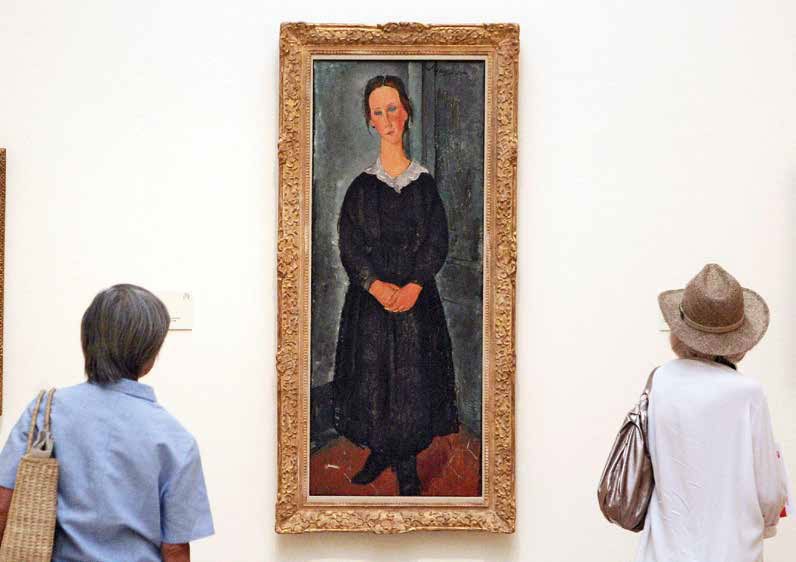
Photos: B. Rindoff Petroff – Getty Images, Fine Art Images / Heritage Images / Getty Images, S. Curry / AFP / Getty Images
Originally published in L’Espresso, September 25, 2026, pp. 64–67 (Current Affairs – Stolen Works of Art). © All rights reserved. English translation of the original Italian article.