
By Catherine Hickley – Sept. 1, 2026
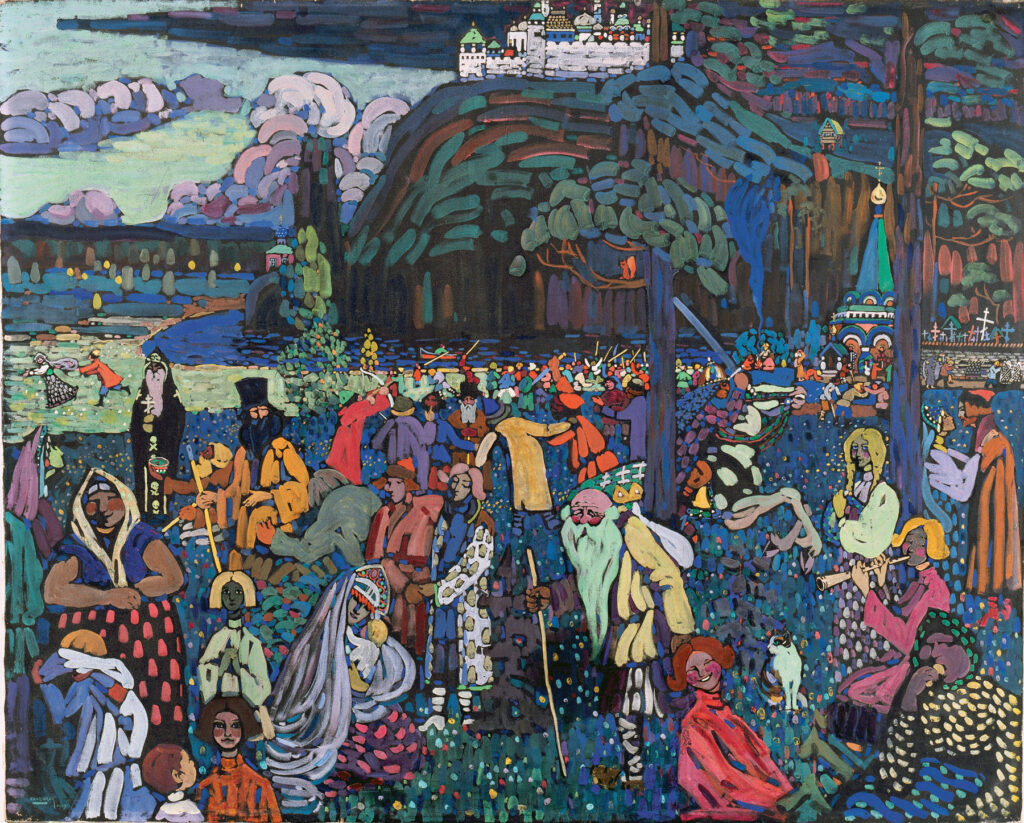
For more than 50 years, an important painting by Wassily Kandinsky, “The Colorful Life,” was held at the Lenbachhaus museum in Munich…
The work had once been in the collection of a Dutch Jewish industrialist, Emanuel Albert Lewenstein, the director of a sewing machine factory, and his wife, Hedwig Lewenstein Weyermann…
…But in 2023, after reviewing the context in which that transaction took place, the German government’s advisory commission on Nazi-looted art recommended it be returned to the Lewenstein family…
…“The Colorful Life” was created in 1907 during Kandinsky’s extended stay in Paris with his former student, partner and fellow artist Gabriele Münter. It was the largest canvas he had so far painted and blends influences from the avant-garde art Kandinsky encountered in Parisian salons and galleries with the cultural traditions of his native Russia…
…“Works of this period are immensely rare,” said Keith Gill, vice chairman of 20th-and 21st-century art at Christie’s. He said the few other paintings from the same chapter of Kandinsky’s life are all in museums.
“It marks a turning-point in modern art and in Kandinsky’s career,” Gill said. “It’s difficult to understate how important this period of time was in Paris in terms of the development of modern art…
…Lewenstein, who acquired a large collection of modern art, bought the painting in 1927. After his death, his wife is believed to have deposited it at the Stedelijk Museum for safekeeping. It was auctioned in October 1940, months after the Nazi invasion of the Netherlands. The German bank, Bayern LB (then called Bayerische Landesbank), acquired it in 1972.
Despite years of research, it has not been possible to determine the circumstances of the 1940 sale, nor who put it up for auction. The German advisory commission said there were many indications the painting was seized as a result of Nazi persecution and it should be assumed that the loss was involuntary in the absence of evidence to the contrary…
…Christie’s plans to display “The Colorful Life” at its premises in Zurich, Paris, New York and Hong Kong in September, and in London from Oct. 8…
…The family is still looking for about 100 artworks, said James Palmer, the founder of Mondex Corporation, which specializes in recovering Nazi-looted art.
“The task is difficult, because many of the artworks are by lesser-known artists and many are drawings or prints,” Palmer said. “We discovered that some artworks have been offered at auctions in the past, and we are doing our best to locate these.”
This is an excerpt from this New York Times article. Full article through this link: Read the full article in The New York Times