
By Alexandre Duyck – January 6, 2026
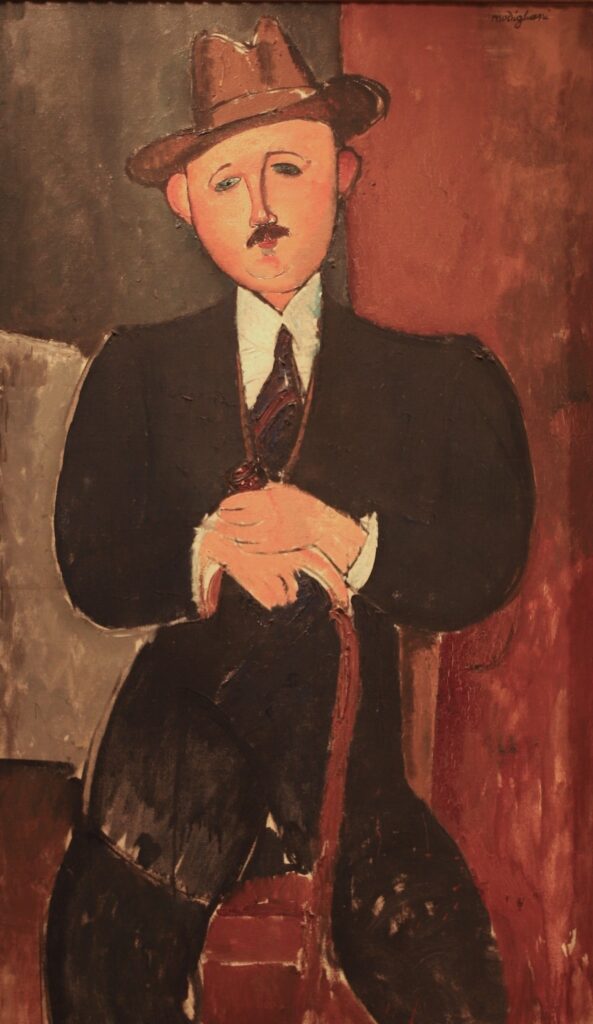
“Seated Man (Leaning on a Cane)”, once owned by a Jewish art dealer forced to flee Paris at the start of the Occupation, lies at the heart of a judicial case full of twists and turns.
“Painted in 1918 by the Italian genius Amedeo Modigliani, the work…has, for years, been at the center of a battle such as the art world has rarely seen. A complex case, involving the spoliation of Jewish property and the murky circuits through which artworks are resold.
“In 1996, “Seated Man” is acquired at Christie’s by a fabulously wealthy collector born in Beirut in 1947, David Nahmad, “
“The problem for father and son Nahmad is that, since 2011, they have been up against a particularly tough adversary, well‑known for never letting go in this type of case. The painting is being claimed by Mondex Corporation, a Canadian firm specializing in tracking down objects looted during the Second World War.”
David Nahmad, now 78, is a born gambler and a backgammon world champion. For a long time he maintained that he had indeed bought the Modigliani at Christie’s in 1996 without suspecting for a second that it might have been stolen by the Nazis.
“American lawyer Phillip C. Landrigan, who works hand in hand with Mondex, files with the New York State Supreme Court a sworn “affirmation” … 54 documents, all showing that, before the war, the painting did in fact belong to the British collector Oscar Stettiner, that he was dispossessed by the Nazis in 1944, and that subsequent sales therefore cannot extinguish his heirs’ right to restitution. The evidence assembled is such that the attorney asks the court to compel the Nahmad family to return “Seated Man” to them.”
“In a written decision handed down on November 17, the New York judges side with him, while stopping short, for now, of coercive measures. They insist in particular on one of the 54 documents, a “note” from the Paris archives dating from 1950 that clearly bears the word “stolen” and of which the Nahmad family, according to its critics (and now the American judiciary), was aware.”
“The small sheet of paper, whose authenticity has been certified, is damning: on one side is a reproduction of the painting; on the other appear the words “stolen”, “Stettiner family”, “Search in America”, “April 1950”. Better still, in mid‑November 2025, the American judges hold that the Nahmad family ought to have produced this document “in response to the plaintiff’s discovery requests”. “
“For the American lawyer, the New York Supreme Court’s opinions of mid‑November 2025 are a source of immense relief: “All of the legal maneuvers and obstruction have failed, and the jury will find not only that the Stettiner family was right to claim that the painting was stolen, but also that David Nahmad knew it and attempted to conceal this fact from the claimant and from the court for decades. Enough is enough!””
“James Palmer, head of Mondex, likewise welcomes these developments… His mission, and that of Mondex Corporation? “To help families whose property was stolen during the Holocaust to recover it by conducting historical and provenance research and then devising restitution strategies,”…
In his view, the issue goes beyond the conduct of the Nahmad family alone. Beyond that, it concerns the art market as a whole. What did the prestigious house of Christie’s know when it put the Modigliani up for sale in 1996?”
This is an excerpt from this Le Monde article. Full article through this link: Spolié par les nazis, caché et bientôt rendu ? La longue odyssée d’un tableau de Modigliani